
SMRs help turn tide on civil nuclear energy
SMRs help turn tide on civil nuclear energy
‘Never say never again’, the title of a classic James Bond film, could apply to the changing attitudes toward civil nuclear energy and the new technologies helping bring nuclear in from the cold. The obvious enthusiasm for small modular reactors (SMRs) and advanced modular reactors (AMRs) is encouraging countries around the world to review their policies on nuclear.
When European Union president Ursula von der Leyen said in a major Paris speech that “it was a strategic mistake for Europe to turn its back on a reliable, affordable source of low-emission power,” her words reflected what others were thinking and, in many cases, acting upon.
The new technology is safer, cleaner, and faster to deploy thanks to the modular design – and there were 127 different designs identified in the OECD Nuclear Agency’s SMR Dashboard report in 2025. The first SMR projects in Europe are expected to become operational in the early 2030s.
In western Europe, with governments facing a social and economic environment that is increasingly hungry for reliable and sustainable electricity, only six of the 17 countries that make up this grouping (including the UK) currently operate nuclear reactors. However, Italy and Germany are both revisiting earlier decisions to close all their nuclear power plants.

Italy opens new discussion on nuclear
In Italy, the prospect of SMRs and AMRs is credited with helping convince politicians in June to pass a bill in parliament that starts a process that could lead to the reintroduction of nuclear power plants in the next decade. “Nuclear energy is now brought back into the national energy policy discussion after a long period of political contention,” wrote Mark Marianello in an analysis for Giovani Universitari in Parlamento.
“[The bill] is first and foremost aimed at advanced technology solutions, mainly SMRs and AMRs,” he said. “In fact, the policy decision was not to go back to old nuclear facilities. Rather, it was an overt move towards Generation III and Generation IV systems, with particular emphasis on modular designs.”
The world as a whole is belatedly waking up to the importance of nuclear power in the overall energy mix. After more than two decades of stagnation, the capacity of the global nuclear fleet is expected to increase by one-third by 2035.
That’s the projection of the latest World Energy Outlook from the International Energy Agency (IEA) based on existing energy policies and the expectation of “a record high in nuclear power output” in 2025.
"Technology advances… are improving the outlook for nuclear power,” says the report. “As demand surges and the need for reliable, low-emission baseload electricity increases, nuclear is increasingly seen as a critical part of a secure, affordable and diverse electricity mix."
It’s a welcome reversal in fortune for the nuclear industry, which had “suffered some decline and stagnation” from the late 1970s to early 2000s, although its share of world electricity generation remained at 16-17 per cent.
Now, with the very public support for nuclear by the current US administration, the French government’s new multiyear energy programme (PPE) putting renewed focus on nuclear, and other countries looking into it, the nuclear industry appears to be gaining momentum. This point was not lost on the international visitors, delegates and exhibitors who attended the 2025 edition of the World Nuclear Exhibition (WNE) in record numbers and contributed to the buzz in the exhibition hall and conference rooms.
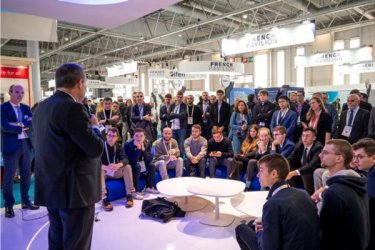
WNE 2023_© Collectif Favart
A new consortium called Nuclitalia will be in charge of studying advanced technologies and analysing market opportunities in the new nuclear sector. Its role will include defining requirements for the Italian system and selecting the most promising solutions.
The Italian government had set up a national platform for sustainable nuclear power in 2023 to define a time frame for the possible resumption of nuclear energy in Italy and identify opportunities for its industrial chain already operating in the sector. The 2026 bill took that one step further by mandating the development of a national programme for sustainable nuclear power.
Photo - Nuclitalia -- Nuclitalia
German ambivalence toward nuclear
Germany meanwhile is grappling with how to achieve its ambitious energy transition goals, which promote renewable sources of energy as alternatives to fossil fuels. Research published in the International Journal of Sustainable Energy found that if the German authorities had not decided in 2002 to abandon nuclear energy, Germany would have achieved its emission control targets at a lower cost than under the current energy policy.
Although returning to nuclear has been categorically ruled out by the chancellor, Friedrich Merz, the debate continues domestically. This is in part due to SMRs, which could contribute to a “resilient, decentralised and low-CO2 energy system”, in the words of economy minister Katherina Reiche. “This is something that our society needs to learn.”
Critics are not convinced. The environment minister, Carsten Schneider, said nuclear energy had already cost taxpayers billions, and as for SMRs, they have been “in the works for decades” and still “struggle to secure subsidies.”
Photo - Katherina --BMWE (Government of Germany)


Substantial private investment in UK
But while Markus Krebber, chief executive of the major German electricity provider RWE, has said private investment in SMRs was not feasible, the Polish nuclear development company SGE – which specialises in SMRs – has taken the opposite position with a substantial investment in the UK.
Under a recently announced plan, SGE will build 14 reactors on three UK sites, broadening the company’s ambition to be at the forefront of SMR development across Europe.
SGE says its proposal reflects a “fleet-based development model, centred on repeatable deployment at scale”. At its heart is the GE Vernova Hitachi BWRX-300 SMR, whose manufacturing partners stress “is not a concept, a plan or a PowerPoint” but a live project now being built in Canada with an estimated completion date of the end of 2029.
The BWRX-300 successfully completed Step 2 of the UK’s generic design assessment in December 2025.
Ironically, the UK’s own Rolls-Royce SMR has been selected over the BWRX-300 by the Swedish utility Vattenfall as it looks to deploy a new generation of reactors. The deal, worth several billion dollars, follows a Swedish government decision to add to its current nuclear capacity with its first new nuclear power plants in 40 years.
Photo - BWRX -- GE Vernova Hitachi
Alliance promotes international collaboration
This is good news to the nuclear energy supply chain, and in particular to the 400 members of the the European Industrial Alliance on Small Modular Reactors (SMRs), an initiative launched in 2024 by the European Union “to facilitate and accelerate the development, demonstration, and deployment of SMRs in Europe by the early 2030s.” The alliance offers free membership to organisations based in, or represented in Europe, which are undertaking relevant activities. Members include GIFEN, the French trade group and organiser of WNE.
The alliance says collaboration is essential to build the robust and efficient supply chain that’s needed to boost SMR development in the EU. “The alliance creates a European platform to enable and streamline such a collaboration,” it says.
With supply chain development one of its themes, WNE 2027 is another platform for building strong working relationships, and as such is a must for companies of every size which are already active, or hope to become active, in the nuclear sector. The event runs 7-9 December 2027 at the Paris Villepinte exhibition park. Exhibitor registration is now open.
At the WNE 2023 conference, Emilie Sauchay, HR Manager of Ineo Nucléaire, discussed their strategic workforce planning for 2022 and 2023. She noted the recruitment of skilled workers as a significant factor but emphasised the necessity of making training programs available for professionals outside of the industry.
“For me, the most important one is to be able to train people in our professions, to be able to attract employees who are not currently in the sector but who would like to join this dynamic sector,” Emilie Sauchay stated. She also added that to support the growth of their workforce, Ineo Nucléaire developed training academies and a network of training centres.