Good time to be in nuclear, says ANS past-president

“Now is a good time to be in nuclear” – words spoken by Dr Hashem M ‘Hash’ Hashemian in 2024 on becoming president-elect of the American Nuclear Society (ANS). Today, as he concludes his year in office, he stands by his comment. He believes nuclear power will remain a cornerstone of sustainable energy for generations to come.
Speaking on the sidelines of the recent ANS annual conference in Denver, Colorado, he said he had “achieved or exceeded” the objectives he set himself for his year in office. By his own reckoning, his forte is networking, and that skillset has helped him expand ANS’s reach into US halls of power as well as deeper into the nuclear industry itself. He’s brought a sharper focus on students and the younger generation, going as far as welcoming kindergarten children to his company, AMS, a global provider of nuclear plant instrumentation and control (I&C) system testing, “to teach them about energy generation, especially nuclear.”
The world as a whole is belatedly waking up to the importance of nuclear power in the overall energy mix. After more than two decades of stagnation, the capacity of the global nuclear fleet is expected to increase by one-third by 2035.
That’s the projection of the latest World Energy Outlook from the International Energy Agency (IEA) based on existing energy policies and the expectation of “a record high in nuclear power output” in 2025.
"Technology advances… are improving the outlook for nuclear power,” says the report. “As demand surges and the need for reliable, low-emission baseload electricity increases, nuclear is increasingly seen as a critical part of a secure, affordable and diverse electricity mix."
It’s a welcome reversal in fortune for the nuclear industry, which had “suffered some decline and stagnation” from the late 1970s to early 2000s, although its share of world electricity generation remained at 16-17 per cent.
Now, with the very public support for nuclear by the current US administration, the French government’s new multiyear energy programme (PPE) putting renewed focus on nuclear, and other countries looking into it, the nuclear industry appears to be gaining momentum. This point was not lost on the international visitors, delegates and exhibitors who attended the 2025 edition of the World Nuclear Exhibition (WNE) in record numbers and contributed to the buzz in the exhibition hall and conference rooms.
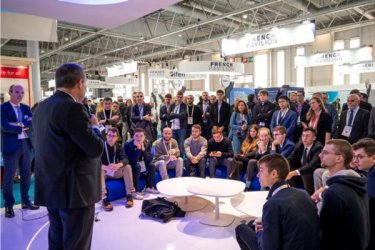
WNE 2023_© Collectif Favart
Dr Hashemian also got behind a push to make ANS more international, including possible ties with WNE, where the level of international participation “surprised” him when he attended the exhibition in Paris. “We’re the largest nuclear organisation in the world but our footprint is linked to the US,” he said. “We should be a lot more than this.”
Advancing ANS’s presence in Europe in both the academic and industry side was “something we can do together,” he added.
One step in that direction came at the ANS conference in Denver, Colorado, when WNE president Sylvie Bermann accepted a Presidential Citation on behalf of the French nuclear industry association GIFEN for “exceptional leadership in delivering a first-class nuclear energy event in Paris”.


Pivotal moment for nuclear energy
The timing of the ANS conference was fortuitous, coming at a “pivotal moment” facing nuclear energy with both fusion and fission sectors on an apparent roll. The conference, run under the theme of Net Out and Power Up, was designed to “examine the technical milestones, financial strategies, and commercialisation pathways required to turn breakthrough innovation into sustained power generation and economic benefit… to power up the future of clean energy.”
Keynote speakers used the platform to repeat, from different perspectives, that nuclear energy was at a turning point. As ANS chief executive Craig Piercy put it in the first session, reported by Nuclear Newswire: “The question before us now is not whether we need more power. We do. The question is whether we can provide that clean, firm generation at a scalable amount to meet that challenge.”
At the WNE 2023 conference, Emilie Sauchay, HR Manager of Ineo Nucléaire, discussed their strategic workforce planning for 2022 and 2023. She noted the recruitment of skilled workers as a significant factor but emphasised the necessity of making training programs available for professionals outside of the industry.
“For me, the most important one is to be able to train people in our professions, to be able to attract employees who are not currently in the sector but who would like to join this dynamic sector,” Emilie Sauchay stated. She also added that to support the growth of their workforce, Ineo Nucléaire developed training academies and a network of training centres.
It was not the time for squabbles between fusion and fission communities. “We are at our best when we stop thinking of ourselves as competing camps and start recognizing that we are part of the same larger project,” he said. A similar message came via Amy Roma, partner at Orrick, Herrington & Sutcliffe and conference general chair. She warned delegates about the dangers of what she called
“bottleneck thinking gone wrong” – focused attention only on the most visible problem when it is “a piece of a much bigger pie that you need to think about holistically.”
Manufacturing capability and lead time woes
Supply chain capabilities and capacity were key concerns expressed by panellists Alexander Valys, president and chief technology officer of Xcimer Energy, a fusion energy company working with laser fusion, and Rita Baranwal, chief nuclear officer of microreactor startup Radiant.
Valys said manufacturing capability and lead times were major supply chain challenges. His company waited a year for a small but crucial component to be fabricated. “If you’re trying to do things on a start-up scale and iterate fast, waiting a year for a fundamental component to build a prototype is pretty terrible,” he said. The industry needed to prioritise scaling up domestic high-end manufacturing capability if it was to succeed.
Baranwal noted “congestion” as companies jockeyed for position in parts of the supply chain, and assessing “who is really serious about their timelines” remained a challenge. Concurring, panel moderator Amy Roma said “noise” across the board made it difficult to identify companies that “can actually support the schedules that they anticipate.”
Inability to deliver on promises
In his interview, Dr Hashemian also expressed disappointment at “our inability to deliver on our promises” on small modular reactors (SMRs) and advanced modular reactors (AMRs). “We’re 10 years behind,” he said bluntly.
He also took exception to over-hyped claims for fusion energy. “I support it long-term – you have to hype it to get investment – but to say we will have electricity on the grid in five years with fusion, it’s probably not possible. The public will see that we lied to them, resulting in a loss of credibility for the whole industry.”
On the other hand, he was “very pleased” that the industry was on course to meet the 4 July deadline set by President Trump for the Reactor Pilot Program which was designed to speed up R&D on advanced reactors. The goal was to reach criticality with at least three of 11 reactor designs selected for the program. “We thought when the goal was set that they should give it two years, but they did it.”
“I’m also proud that things are starting to get constructed,” he said, citing two demonstration reactors at Oak Ridge, Tennessee: Kairos Power’s Hermes 1 and 2.
He said he looked forward to better integration between ANS and WNE. That could be in evidence at WNE 2027, which opens for three days at the Paris Nord Villepinte exhibition centre on 7 December. Registration for exhibitors is now open.