Africa is on the move toward adopting nuclear


Africa has a bright future, driven by its young population and uptake of new technologies. The continent is resource-rich, and projections suggest it will be home to the world’s largest workforce by 2050. With that will come huge challenges for its leadership: challenges of economic growth, standard of living, sustainability, and sovereignty.
The key challenge for African economies, in the view of President Paul Kagame of Rwanda, is energy, and nuclear has a distinct role to play.
In his keynote address to the second Nuclear Energy Innovation Summit on Africa (NEISA) in Kigali, he said: “For Africa, energy is not simply a development issue. It is the foundation of industrial growth and competitiveness.” Without significant amounts of reliable energy, countries “will struggle to compete.”
Rwanda, which is on track to start nuclear power generation by the early 2030s, views small modular reactors (SMRs) as the most practical way forward as they are suited to the realities of most African countries. “This is larger than any one country,” President Kagame said. “We are moving the conversation beyond ambition to practical coordination and financing mechanisms that can sustain deployment at scale.”
The world as a whole is belatedly waking up to the importance of nuclear power in the overall energy mix. After more than two decades of stagnation, the capacity of the global nuclear fleet is expected to increase by one-third by 2035.
That’s the projection of the latest World Energy Outlook from the International Energy Agency (IEA) based on existing energy policies and the expectation of “a record high in nuclear power output” in 2025.
"Technology advances… are improving the outlook for nuclear power,” says the report. “As demand surges and the need for reliable, low-emission baseload electricity increases, nuclear is increasingly seen as a critical part of a secure, affordable and diverse electricity mix."
It’s a welcome reversal in fortune for the nuclear industry, which had “suffered some decline and stagnation” from the late 1970s to early 2000s, although its share of world electricity generation remained at 16-17 per cent.
Now, with the very public support for nuclear by the current US administration, the French government’s new multiyear energy programme (PPE) putting renewed focus on nuclear, and other countries looking into it, the nuclear industry appears to be gaining momentum. This point was not lost on the international visitors, delegates and exhibitors who attended the 2025 edition of the World Nuclear Exhibition (WNE) in record numbers and contributed to the buzz in the exhibition hall and conference rooms.
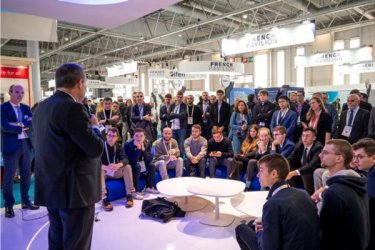
WNE 2023_© Collectif Favart
WNE was among strategic partners of NEISA 2026, with WNE president and ambassador of France Sylvie Bermann taking part in its proceedings. She praised the commitment of President Kagame and said in an interview that France considers it “important for the overall nuclear sector to have Africa on board”.
Fast resolution to energy challenge
President Kagame said the “strong participation” at NEISA 2026 underlined a growing consensus that the future of African economies depended on how quickly they could solve the energy challenge. At the core of this challenge was finance; the conference took as its theme ‘Powering Africa’s future: Turning nuclear energy ambition into investable reality’.
“Too often investors hesitate because they perceive many risks in Africa,” he said. “We must work to strengthen regulation, ensure consistency and accountability in order to build confidence and attract long-term capital.”
He cautioned against fragmentation of efforts, saying: “If countries work in isolation, progress will be slow and far more costly. Cooperation… is essential.
“By 2050, Africa will have the largest work force in the world. The democratic shift can become one of the greatest economic advantages of this century if we prepare for it.”
‘Home-grown’ African solution
Dr Lassina Zerbo, chair of the Rwanda Atomic Energy Board (RAEB), told delegates that President Kagame was instrumental in the formation of NEISA by encouraging a ‘home-grown’ solution: a pan-African conference to which Africans could invite those with the expertise they needed to replicate their successes in Rwanda, and around Africa.
Financing – the focus of the 2026 NEISA conference – will always be an issue. But Africa was not waiting. The continent is where “the largest industrial transformation of our century” will happen, and with the rise of SMR and MMR technology, for the first time “nuclear energy fits the African context.”
In his keynote to the conference, he said Africa is “living through a historic moment” as it pivots away from being mainly a source of the strategic resources needed for the global energy transition, to being a user of its own rich reserves.
The continent could not afford to be a bystander of this new energy era. “Africa should not simply aspire to have a seat at the table,” said Dr Zerbo, “Africa must help shape the table itself. And that’s what we’re trying to do at NEISA.”


Global Coalition for Nuclear Philantropy
He welcomed the renewed interest of global financial institutions in investments in civil nuclear energy. Other sources of finance were also coming forward. Dr Zerbo used the NEISA platform to announce the formation of the Global Coalition for Nuclear Philanthropy (GCNP), an initiative led by the Rockefeller Foundation and Temasek Trust to mobilise philanthropic capital in support of nuclear energy as a driver for clean energy security, economic growth, energy abundance, and human development.
“With sustainable financing models, strong international partnerships, build-up of institutional capacity and technology such as SMRs, Africa will be able to move forward,” he said. “The truth is simple: without nuclear energy as part of the solution, sustainable large-scale energy abundance and sovereignty will remain out of reach.
“We have a long road ahead but Africa is ready to embrace this challenge.”
At the WNE 2023 conference, Emilie Sauchay, HR Manager of Ineo Nucléaire, discussed their strategic workforce planning for 2022 and 2023. She noted the recruitment of skilled workers as a significant factor but emphasised the necessity of making training programs available for professionals outside of the industry.
“For me, the most important one is to be able to train people in our professions, to be able to attract employees who are not currently in the sector but who would like to join this dynamic sector,” Emilie Sauchay stated. She also added that to support the growth of their workforce, Ineo Nucléaire developed training academies and a network of training centres.
Dr Zerbo emphasised that NEISA will be judged on concrete actions stemming from its discussions. One such was the agreement signed on the fringes of the conference between NEISA and the French nuclear industry trade group GIFEN – the organizer of WNE – to expand cooperation on helping Africa plot its own energy transformation. Already there’s talk of a much bigger group of African companies taking part in WNE 2027.
Leadership very positive
Ambassador Bermann applauded the Franco-African agreement and confirmed that France will be at NEISA 2027 in Togo, and as for an African pavilion or corner at WNE 2027, “we’re working on that.”
She noted an air of excitement at the conference. “The leadership is very positive,” she said. “They all believe in nuclear energy; they absolutely need it [for their development]. There’s a real determination.”
Speaking on a panel, she said France’s deep experience showed it was vital to make nuclear energy a “strategic national project”.
“[Nuclear energy] is a long-term investment and a obviously has to be a long-term policy – you can’t change when you change your government.”

Build talent alongside new nuclear plant
Alongside policy and reliable regulation, “you need the talent,” she said, adding: “It has to start at the same time that you decide to build a new nuclear plant.”
Everything France has implemented can be implemented in Africa, she said.
Dr Zerbo, who led a small delegation to WNE 2025, said NEISA – like WNE – gave Africans an opportunity to build relationships with international partners, and gave international companies a forum for meeting some of the 30+ African countries that are interested in implementing nuclear projects.
“Everyone knows we can’t grow alone,” he said. “There’s no sense in that. We have to work together, with international partners, to make sure we can accomplish our ambitions in the early 2030s.”