Nuclear energy gets a global stage at Davos 2026

Nuclear energy may not have been at the top of the agenda, but as an enabling technology, it was very much ‘in the room’ at the recent World Economic Forum (WEF) annual meeting in Davos. Interestingly – some would say inevitably – many of the presentations on nuclear energy, or in which it figured, mirrored themes of WNE 2025 just two months earlier.
The message was clear: the leaders attending and networking at both these major world events are on the same page in their deliberations about the future of humanity.
“The conversations at Davos reveal a growing consensus and a clear market signal: nuclear energy has emerged as an imperative across national energy agendas,” reported Amy Drake of the Atlantic Council’s Global Energy Center. “The successful deployment of nuclear energy technologies at scale rests on dedicated policies, investments, and cooperation to ensure a secure and sustainable energy system.”
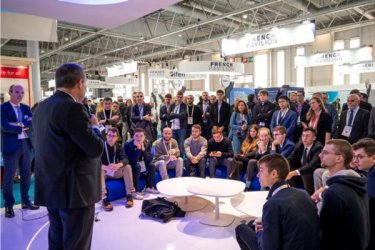
One of the standout features of WNE is the Connect to Nuclear program—an initiative launched in 2023 that aims to attract young talent and those considering professional retraining by offering them a unique platform to meet the global civil nuclear community. Equipped with conferences with experts, testimonials from intern and junior profiles, animation and workshops, guides tour of the show and networking opportunities with industry players, the program provides participants with a well-rounded introduction to the industry.
WNE 2023_© Collectif Favart
BEE themes reflected at Davos
Themes highlighted at WNE 2025, notably in the innovative Beyond Electricity Exhibition (BEE) feature, resonated throughout discussions at the forum’s annual meeting in the Swiss ski resort of Davos-Klosters from 19-23 January, and dovetailed neatly with Davos 2026’s own stated themes: cooperation, innovation, growth, building prosperity, and investing in people.
Rafael Mariano Grossi, director general of the International Atomic Energy Agency (IAEA) said that when governments, international organisations and the world business community come together in one place, it was important for the IAEA to be there too.
“The work of the IAEA is at the centre of the debates,” he said. “In particular the nexus between nuclear energy and AI has attracted a lot of attention, but also importantly our work on food, nutrition and human health.”
Nuclear’s role beyond electricity
At WNE 2025, Grossi had joined WNE president Sylvie Bermann to officially open the BEE area which showcased the key role of nuclear outside its use to generate electricity. Exhibitors showed the technology’s use in industries including medicine, agriculture, space, hydrogen production, industrial-scale heat, and desalination.
At Davos, the IAEA and WEF brought together leaders of African countries exploring nuclear energy options, one of whom, Julius Maada Bio, president of Sierra Leone, said: “We have to imagine a future that is sustainable.”
“The mission [and] the importance of the IAEA continue to grow,” said Grossi. “This is why we are in Davos.”
A panel discussion on the ‘Nuclear renaissance: seeing with clear eyes’, moderated by the Economist’s Vijay V Vaitheeswaran, offered strong evidence that nuclear power is regaining momentum as advances in reactor design and fission science address “surging demand” for reliable, scalable energy.
Its international group of panellists including Bernard Fontana, chief executive of EDF, Michael McKelvy of CH2M Hill, Swedish energy minister Ebba Busch, and Eisaku Ito, head of Mitsubishi Heavy Industries.
At the WNE 2023 conference, Emilie Sauchay, HR Manager of Ineo Nucléaire, discussed their strategic workforce planning for 2022 and 2023. She noted the recruitment of skilled workers as a significant factor but emphasised the necessity of making training programs available for professionals outside of the industry.
“For me, the most important one is to be able to train people in our professions, to be able to attract employees who are not currently in the sector but who would like to join this dynamic sector,” Emilie Sauchay stated. She also added that to support the growth of their workforce, Ineo Nucléaire developed training academies and a network of training centres.


International Energy Agency boss Fatih Birol agreed. Speaking on a panel on energy security, he called for new thinking in energy diplomacy. “Energy and geopolitics were always interwoven but I have never ever seen that the energy security risks are so multiplied,” he said. “Energy security, in my view, should be elevated to the level of national security today.”
In this context, he noted an upsurge in interest in nuclear and renewables in countries pursuing self-sufficiency in energy by generating their own. Reliable partners, he suggested, were as important now as costs.
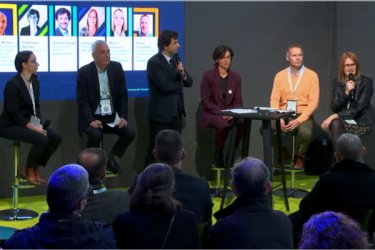
Screen grabbed from Youtube
Europe promoting investment in nuclear
European Commission President Ursula von der Leyen, in a keynote speech, described the EU’s approach as promoting investment in nuclear and renewables “to bring down prices and cut dependencies; to put an end to price volatility, manipulation and supply shocks… because homegrown, reliable, resilient and cheaper energy will drive our economic growth and deliver for Europeans and secure our independence.”
Artificial intelligence (AI) had a raised profile at WNE 2025, underlining the growing symbiosis between these technological worlds, and others. Sama Bilbao y León, chief executive of the World Nuclear Association (WNA) and a popular speaker at WNE, in an interview with CNBC-TV18, pointed to equally strong interest from industrial sectors such as chemicals and metallurgy, all looking to nuclear “to power their processes”.
“We’re seeing lots of partnerships with big players,” she added.

Private finance interest in nuclear
What makes this a possible inflection point is the level of interest in nuclear energy from private finance, she said. But it is not straightforward: in many cases, investors needed government involvement, “not financial, but in policy and long-term planning”. As an example, she cited the oversubscription of investment for the UK’s Sizewell C development following release of the UK government’s revised national policy statement for nuclear energy generation.
Part of what’s good about the nuclear industry, Bilbao y León said, is the geographic spread and diversity of the supply chain. “It’s a global industry where everyone is working together.”
That spirit of international cooperation and collaboration will be in full view again in December 2027 when the seventh edition of WNE opens its doors at Paris Villepinte exhibition centre for what organisers RX France and GIFEN expect to be another record-breaking year.
#World Economic Forum
#WEF2026
#Nuclear renaissance
#WNE2025
#WNE2027
#GIFEN
Photo credit: World Economic Forum Annual Meeting