Industry urged to ‘demystify’ nuclear to attract more investors

The nuclear industry needs a staggering US$6 trillion of investment over the next 24 years to meet global ambitions – and it needs significant input from both private and public sources of finance to reach that target.
That’s the thrust of the newly published World Nuclear Investment Guide which has been compiled by the World Nuclear Association (WNA) with input from leaders of both nuclear and finance sectors, and launched to coincide with this year’s World Nuclear Symposium in London.
The guide’s authors based their estimate of the investment needed across the board to reach the total global capacity of 1,446 GWe by 2050 – roughly 3.5 times today’s capacity of operable reactors – that they calculated by combining government targets with total current industry activity.
The world as a whole is belatedly waking up to the importance of nuclear power in the overall energy mix. After more than two decades of stagnation, the capacity of the global nuclear fleet is expected to increase by one-third by 2035.
That’s the projection of the latest World Energy Outlook from the International Energy Agency (IEA) based on existing energy policies and the expectation of “a record high in nuclear power output” in 2025.
"Technology advances… are improving the outlook for nuclear power,” says the report. “As demand surges and the need for reliable, low-emission baseload electricity increases, nuclear is increasingly seen as a critical part of a secure, affordable and diverse electricity mix."
It’s a welcome reversal in fortune for the nuclear industry, which had “suffered some decline and stagnation” from the late 1970s to early 2000s, although its share of world electricity generation remained at 16-17 per cent.
Now, with the very public support for nuclear by the current US administration, the French government’s new multiyear energy programme (PPE) putting renewed focus on nuclear, and other countries looking into it, the nuclear industry appears to be gaining momentum. This point was not lost on the international visitors, delegates and exhibitors who attended the 2025 edition of the World Nuclear Exhibition (WNE) in record numbers and contributed to the buzz in the exhibition hall and conference rooms.
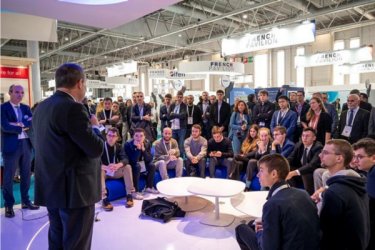
WNE 2023_© Collectif Favart
Speaking on the World Nuclear News (WNN) podcast, lead author Dr Lola Infante said many in the finance community “are interested in nuclear, but they're not sure where or how to engage.”
“What we want to do with the guide is to show them the different types of opportunities that are arising and that are available at different price points or risk levels.
“The core of the problem is that if we are to scale nuclear to triple capacity by 2050, then we need to unlock investment. We needed to demystify nuclear and start seeing it as just another infrastructure asset class.”
Industry’s responsibility
This is one of the challenges taken on by WNE 2027 in planning for the next edition of its global industry showcase, which runs from 7–9 December next year. The integration of private investment is one of the show’s central themes, and with the entire civil nuclear ecosystem expected to be represented at the Paris Nord Villepinte show site, there can be no better time for discussions on building investor confidence through clear, long-term national policies and “bridging the gap between strategy and deployment”.
The way forward, as articulated by WNA director-general Dr Sama Bilbao y León at the Finance Summit on the first day of symposium, in essence ‘flips’ responsibility onto the industry to define projects that are “investible” rather than expecting investors to identify them on their own. She said: “Nuclear energy must be financed not as an exception, but as a mainstream asset class... this is not just an energy investment story. It is essentially a development story and ultimately it is a societal story.”

Multiple surveys suggest the renewed global interest in nuclear power is driven by society’s pursuit of sustainability and decarbonization goals and energy security, with surging demand for electricity from digital infrastructure and electrification a growing concern. While these forces are real, insiders say they understate the challenge.
Specifically, the challenge lies in how nuclear projects are financed, how risk is allocated, and how investors assess credibility in a sector defined by long timelines and asymmetric downside risk.
Rebuilding US nuclear supply chain
In the USA, rebuilding that country’s nuclear supply chain has taken on a new urgency under the current administration. In July, the federal government took a step in that direction when the Department of Energy (DoE) announced a loan programme worth $17.5 billion to support development of five nuclear facilities running 10 Westinghouse AP1000 reactors.
The loans, while amounting to a very large ‘carrot’ to industry to seize the moment, are conditional on Westinghouse and its utility partners each committing $500 million per project.
The action of the US administration in this instance also supports the thesis that the public sector should be an enabler and catalyst of project finance, not a substitute for private investment. It is a point reiterated by the new investment guide.
Governments, alongside their role legal and regulatory functions, continue to be “a main de-risker and main financier of nuclear projects,” said Dr Infante. “But we do need to bring in private capital.”
Comparing nuclear to other industries, she said the average annual investment of US$250 billion that was estimated would be needed to meet government ambitions, while less than some industries spend, was more than governments alone can finance. The investment guide offered a roadmap to help the industry arrive at “a situation where nuclear is just like any other asset class, where risks are known, they're understood, they're priced… where we have large pools of private capital participating in the market, where there is liquidity in the market, where nuclear financing is not only, or predominantly, a government thing.”

EIB’s first investment in nuclear
The European Investment Bank (EIB) in September sent a message to the banking industry when it announced its decision to invest up to EUR40 million in Steady Energy, a Finnish start-up developing its SMR design. Steady Energy said the investment was “part of a broader financing package involving institutional, strategic and retail investors and is backed by the European Union’s InvestEU programme”. It was intended to support R&D, testing and licensing activity through 2028, leading to commercial deployment of the company’s new technology.
The investment by the EIB, one of the largest multilateral development banks in the world, represents its first financing of SMR technology and forms part of the bank’s broader efforts to support European clean-energy innovation, competitiveness and energy security. Emmanuel Brutin, head of the Nucleareurope trade association, said the EIB’s support sent “a positive signal to investors.”
EIB Group vice-president Karl Nehammer said in a statement the support to Steady Energy was “a flagship example of how the EIB Group is backing innovation to strengthen Europe’s competitiveness, enhancing energy autonomy and expanding access to affordable clean energy.”
Support for nuclear, by no means unanimous in Europe, is a debate guaranteed to attract input from the entire nuclear industry.
Register as an exhibitor for WNE 2027 and put yourself at the heart of important discussions that will help shape the future.
At the WNE 2023 conference, Emilie Sauchay, HR Manager of Ineo Nucléaire, discussed their strategic workforce planning for 2022 and 2023. She noted the recruitment of skilled workers as a significant factor but emphasised the necessity of making training programs available for professionals outside of the industry.
“For me, the most important one is to be able to train people in our professions, to be able to attract employees who are not currently in the sector but who would like to join this dynamic sector,” Emilie Sauchay stated. She also added that to support the growth of their workforce, Ineo Nucléaire developed training academies and a network of training centres.