Industry signals readiness to champion nuclear energy

We are ready – that was the key message from the international nuclear industry at the 2026 Nuclear Energy Summit (NES) convened in Paris by the French government in collaboration with the International Atomic Energy Agency (IAEA).
As if in response, the European Union used the occasion to announce new financial support for innovative nuclear technologies, plus a strategy for small modular reactors (SMEs).
The event on 10 March, described as an international summit to promote the vision of a trustworthy, safe and peaceful civilian nuclear industry, sought to bring about concrete initiatives and encourage partnerships between stakeholders. The second such global meeting, it attracted leaders and energy officials from 41 countries.
We are ready – that was the key message from the international nuclear industry at the 2026 Nuclear Energy Summit (NES) convened in Paris by the French government in collaboration with the International Atomic Energy Agency (IAEA).
As if in response, the European Union used the occasion to announce new financial support for innovative nuclear technologies, plus a strategy for small modular reactors (SMEs).
The event on 10 March, described as an international summit to promote the vision of a trustworthy, safe and peaceful civilian nuclear industry, sought to bring about concrete initiatives and encourage partnerships between stakeholders. The second such global meeting, it attracted leaders and energy officials from 41 countries.
In a speech to the assembled delegates, European Commission president Ursula van der Leyen said the decline in Europe’s use of nuclear power since the 1990s had been “a strategic mistake” that the new EUR200 million investment guarantee would help correct. The funding would support nuclear and renewables to become “the joint guarantors of independence, security of supply, and competitiveness”.
To help return Europe to its former pioneering role in nuclear technology, she announced a new European strategy for SMRs designed to align development efforts across member states. “The logic is clear,” she said. “When [the technology] is safe to deploy, it must be simply to deploy – all across Europe.”
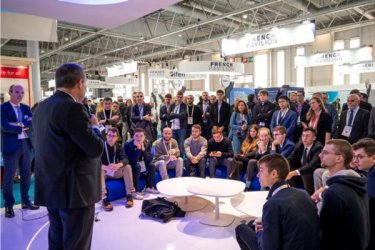
WNE 2023_© Collectif Favart
In a speech to the assembled delegates, European Commission president Ursula van der Leyen said the decline in Europe’s use of nuclear power since the 1990s had been “a strategic mistake” that the new EUR200 million investment guarantee would help correct. The funding would support nuclear and renewables to become “the joint guarantors of independence, security of supply, and competitiveness”.
To help return Europe to its former pioneering role in nuclear technology, she announced a new European strategy for SMRs designed to align development efforts across member states. “The logic is clear,” she said. “When [the technology] is safe to deploy, it must be simply to deploy – all across Europe.”
Nuclear industry speaking with one voice
Industry support is all but guaranteed after a joint statement by 25 international associations brought together by GIFEN declared that nuclear energy must remain a key pillar of sustainable, safe, and resilient energy systems. The global nuclear industry was mobilised and ready to fully assume its role as a guarantor of energy security and a catalyst for economic development.
Addressing the summit, GIFEN president Xavier Ursat said the international nuclear industry “speaks with one voice” through this statement while reaffirming “the determination and commitments of the nuclear industry”.
These commitments include tripling global nuclear capacity by 2050 to meet energy demand and carbon neutrality targets; supporting nuclear power’s role in cutting dependence on fossil fuels; expanding its use beyond electricity; safety through training and operational excellence; and finding the right financial frameworks to pursue these and other ambitions.
Supporting Ursat at the event were WNE president Sylvie Bermann, GIFEN chief executive Olivier Bard and international director Mathieu Euvrard, and Farahnaz Laldjee, secretary general of WNE.
Encouraging initiatives and partnerships
The IAEA, co-sponsor of the event with the International Energy Agency (IEA), said the summit represented an important opportunity to strengthen international cooperation and promote real-world solutions for the safe and sustainable development of civil nuclear power. In addition to facilitating dialogue, the summit aimed to encourage the development of initiatives and partnerships among countries, international organizations, financial institutions and industry.
"Nuclear power is not simply a nice-to-have, or a cleaner option,” said IAEA director general Rafael Mariano Grossi. “It is a strategic opportunity and we know it.
“When we speak about development, we speak about electrification, digitalisation and artificial intelligence; in all these areas, we will need reliable and predictable answers. Nuclear energy is one of those answers.”
IEA executive director Fatih Birol said Europe in particular has an interest in strengthening energy sovereignty by expanding domestic clean energy capacity. He said this strategy would include scaling up renewable sources such as solar and wind while also enabling what he described as a “strong comeback” for nuclear power in the global energy mix.
Vulnerability exposed by Middle East war
In his opening remarks, French president Emmanuel Macron said the Middle East war had exposed a vulnerability in Europe’s energy independence, and called on countries to increase their use of nuclear power.
"Nuclear power is key to reconciling both independence – and thus energy sovereignty – with decarbonisation, and thus carbon neutrality," Macron said. "We can see it in our current geopolitical context: when we are too dependent on hydrocarbons, they can become a tool of pressure, or even of destabilisation.”
Panellists in afternoon discussions and roundtables picked up on these themes, alongside their focus on emerging technologies, financing solutions, innovation, development of skilled workforces and the future role of nuclear energy.
At the WNE 2023 conference, Emilie Sauchay, HR Manager of Ineo Nucléaire, discussed their strategic workforce planning for 2022 and 2023. She noted the recruitment of skilled workers as a significant factor but emphasised the necessity of making training programs available for professionals outside of the industry.
“For me, the most important one is to be able to train people in our professions, to be able to attract employees who are not currently in the sector but who would like to join this dynamic sector,” Emilie Sauchay stated. She also added that to support the growth of their workforce, Ineo Nucléaire developed training academies and a network of training centres.

Kigali poised to stage first African summit
Among heads of state in attendance was Rwandan president Paul Kagame whose presence served to highlight the upcoming Nuclear Energy Industry Summit Africa (NEISA) – the first continental summit entirely dedicated to civil nuclear power – which will be held in his capital, Kigali, from 18-21 May.
The event will bring together governments, industry leaders, regulators and financial institutions to discuss the growing opportunities for nuclear technologies in Africa.
Rwanda is positioning itself as a regional leader in nuclear energy by advancing its programme and exploring SMRs for a sustainable, low-carbon future.
More countries join ‘coalition of the ambitious’
Rwanda had signed up at COP30 in Brazil to the Declaration to Triple Nuclear Energy, the so-called ‘coalition of the ambitious’. The Paris summit saw four more countries – China, Brazil, Italy and Belgium – commit to the goal of at least tripling global nuclear energy capacity by 2050, bringing to 38 the number of countries signed up to the declaration.
China – the world leader in new nuclear construction with 29 reactors currently being built – said its support for the declaration, first communicated in 2023 at COP28 in the UAE with the support of 25 countries, reflected its desire and readiness “to work with all related parties to implement the building of a community with a shared future for all”.
Speaking at the summit, WNE director general Sama Bilbao y León said: "Today's announcement adds tremendous momentum to the global coalition of the ambitious…. Collectively, governments and industry must now turn this ambition into action and deliver."